

Leg pain that appears when you walk can be frustrating and confusing. You may notice aching in your calf after walking a certain distance, pain around your knee, or a burning sensation that travels from your lower back into your leg. Sometimes the discomfort improves when you rest. Other times, changing your position seems to make the biggest difference.
Those details matter because leg pain when walking can have several different causes. Peripheral artery disease (PAD), arthritis, and sciatica can all make walking uncomfortable, but they do not affect the body in the same way.
PAD is related to reduced blood flow through the arteries supplying the legs. Arthritis involves inflammation or degeneration of a joint, while sciatica usually involves irritation or compression of a nerve that travels from the lower back toward the leg.
The challenge is that symptoms can overlap. A person with knee arthritis may have calf discomfort because they are changing the way they walk. Someone with back problems may describe their leg symptoms simply as “circulation problems.” And someone with PAD may initially assume the pain is just part of getting older.
The pattern of your pain—when it starts, where you feel it, what makes it worse, and what makes it better—can provide im
portant clues.
Important Note: New, severe, rapidly worsening, or unexplained leg pain should be medically evaluated. Sudden severe leg pain accompanied by a cold, pale, blue, numb, or unusually weak leg can indicate a serious circulation problem and requires urgent medical attention.
Is Leg Pain When Walking More Likely to Be PAD, Arthritis, or Sciatica?
It depends on the pattern of the pain. PAD often causes aching, cramping, or tiredness in the muscles—frequently the calf—after walking or exercising. The discomfort typically improves after resting.
Arthritis is more likely to produce pain centered around an affected joint, such as the knee or hip. The joint may feel stiff, sore, swollen, or painful when you move it or put weight on it. Symptoms may be worse after prolonged activity, although arthritis patterns vary.
Sciatica often produces pain that follows the path of the sciatic nerve, commonly traveling from the lower back or buttock down the back or side of the leg. It may feel sharp, burning, shooting, or electric rather than like a simple muscle ache.
These descriptions are useful clues, but they are not enough to diagnose the cause by themselves. A healthcare professional may need to examine your legs, check circulation, assess your joints and nerves, and order appropriate testing.
What Does PAD Leg Pain Feel Like?
Peripheral artery disease develops when arteries supplying the legs become narrowed or blocked, reducing blood flow to the muscles. One of the classic symptoms is intermittent claudication, which refers to muscle pain or discomfort brought on by walking or exercise and relieved by rest.
Imagine walking through a grocery store. At first, you feel fine. After several minutes, your calf begins to ache or cramp. You stop beside an aisle or sit down, and after a short period the discomfort improves. You start walking again, and the same pattern returns.
That repeatable relationship between activity and pain can be an important clue to PAD.
PAD-related discomfort is often felt in the calf, but it can also occur in the thigh, buttock, hip, or foot depending on where blood flow is reduced.
Some people describe the sensation as cramping, aching, heaviness, fatigue, or tightness. Others may notice that one leg becomes tired sooner than the other.
As PAD becomes more advanced, symptoms may occur with less activity or even while resting. Additional signs can include a cooler foot, changes in skin color, slower-growing toenails, reduced hair growth on the legs, or wounds that are slow to heal.
Not everyone with PAD experiences the classic “pain every time I walk” pattern. Some people have mild symptoms, while others may have no obvious symptoms at all.
Apex Heart & Vascular Center provides evaluation for leg pain and claudication w
hen vascular causes are suspected.
What Does Arthritis Leg Pain Feel Like?
Arthritis affects joints rather than the arteries or nerves. The symptoms therefore often center around a particular joint.
For example, knee arthritis may cause pain around or inside the knee, particularly when standing, climbing stairs, getting up from a chair, or walking for an extended period. Hip arthritis may cause discomfort around the hip or groin and can make certain movements difficult.
Stiffness is another important clue. You may feel particularly stiff after sitting for a while or when you first start moving. Depending on the type and severity of arthritis, the joint may also become swollen or tender.
Unlike classic PAD claudication, arthritis pain does not necessarily follow a predictable “walk until pain starts, stop and quickly recover” pattern.
However, there can be overlap. A person with arthritis may experience more pain as they walk farther, and resting may provide relief. That is why simply asking whether the pain improves when you stop walking is not enough to distinguish arthritis from PAD.
The location and quality of the discomfort, joint examination, medical history, and sometimes imaging can help determine whether arthritis is contributing to your symptoms.
What Does Sciatica Leg Pain Feel Like?
Sciatica is different from PAD and arthritis because it involves a nerve pathway.
The sciatic nerve travels from the lower back through the buttocks and into the leg. When a nerve root in the lower back becomes irritated or compressed, pain can travel along this pathway.
People with sciatica often describe the pain as sharp, shooting, burning, tingling, or electric. Instead of feeling like a deep muscle cramp, the discomfort may seem to travel from one area to another.
You may also experience numbness or weakness in part of the leg or foot.
Body position can be an important clue. Sciatica symptoms may change when you sit, stand, bend, twist, or change the position of your spine. Coughing or sneezing may sometimes worsen symptoms because of increased pressure around irritated nerves.
However, sciatica does not always follow a textbook pattern. Back and leg conditions can overlap, and not every person experiences the same symptoms.
PAD vs Arthritis vs Sciatica: Key Differences
Although these conditions can all interfere with walking, their typical symptom patterns are different.
PAD
PAD often causes muscle aching, cramping, heaviness, or fatigue after walking or exercise. The discomfort may appear after a fairly predictable amount of activity and improve after resting. The calf is a common location, although other parts of the leg can be affected.
Arthritis
Arthritis usually produces pain associated with a particular joint, often accompanied by stiffness or reduced range of motion. Weight-bearing activities and joint movement may aggravate symptoms.
Sciatica
Sciatica commonly causes pain that travels from the lower back or buttock into the leg. Burning, shooting, tingling, numbness, and weakness may occur because a nerve is involved.
These are general patterns rather than strict rules. A person can have more than one condition at the same time.
Why Does the Pain Start When You Walk?
This is one of the most useful questions to ask when trying to understand walking-related leg pain.
When you walk, your leg muscles need more oxygen. Your circulation has to deliver enough oxygen-rich blood to meet that increased demand.
With PAD, narrowed arteries can limit how much blood reaches the working muscles. At rest, blood flow may be sufficient. Once you begin walking, however, the muscles need more oxygen than the circulation can deliver. The resulting mismatch can cause the characteristic aching or cramping of claudication.
Arthritis follows a different mechanism. Walking places mechanical stress on affected joints. If cartilage, bone, or surrounding tissues are affected by arthritis, repeated movement and weight-bearing can increase discomfort.
Sciatica is different again. Walking changes the position and loading of the spine, pelvis, and lower limbs. In some people, certain movements or positions can aggravate an irritated nerve.
This is why the relationship between activity and symptoms can be so informative.
Where Do You Feel the Pain?
The location of your pain can offer another clue, although it cannot provide a diagnosis by itself.
PAD commonly causes discomfort in the calf when the narrowing affects arteries supplying the lower leg. If narrowing occurs higher in the arterial system, symptoms may occur in the thigh, buttock, or hip.
Arthritis pain is generally concentrated around the affected joint. Knee arthritis, for example, may cause discomfort around the knee rather than a predictable cramping sensation in the calf.
Sciatica tends to follow a nerve distribution. The discomfort may begin around the lower back or buttock and travel down one leg.
Sometimes the distinction is not obvious. Pain can radiate, and people may use different words to describe similar sensations. That is one reason a proper medical assessment matters when symptoms persist.
What Happens When You Stop Walking?
What happens after you stop walking can provide another useful clue, particularly when doctors are evaluating possible peripheral artery disease.
With classic intermittent claudication caused by PAD, leg discomfort often improves after you stop exercising and allow the muscles to rest. You may be able to stand still for several minutes and notice that the aching or cramping gradually fades. When you begin walking again, the discomfort may return.
This repeatable pattern is different from many musculoskeletal conditions, although there can be overlap.
For example, arthritis pain may continue after you stop walking, particularly if the joint remains irritated. You might feel discomfort while sitting, standing, climbing stairs, or getting up from a chair.
Sciatica may also continue while you are resting. In fact, certain sitting or lying positions can make nerve-related pain worse, while another position may provide relief.
That means the question is not simply, “Does resting make the pain better?” Instead, your healthcare provider may want to know how quickly the pain improves, whether it reliably returns when you walk again, and whether changing your body position affects it.
Other Symptoms That Can Help You Tell the Difference
Leg pain is only one piece of the puzzle. Other symptoms may provide important clues about whether the problem involves circulation, joints, or nerves.
Symptoms That May Point Toward PAD
In addition to walking-related leg pain, PAD may cause a number of circulation-related changes. You might notice that one foot feels cooler than the other, the skin looks unusually pale or bluish, or a minor wound takes longer than expected to heal.
Some people notice reduced hair growth on the lower legs or changes in their toenails. Others develop pain in the foot or leg while resting, particularly when PAD becomes more advanced.
These symptoms do not prove that you have PAD, but they are worth discussing with a healthcare professional.
PAD is also associated with cardiovascular disease elsewhere in the body. The arteries supplying the legs are part of the same vascular system that supplies the heart and brain, so identifying PAD can be an important part of assessing overall cardiovascular health.
Symptoms That May Point Toward Arthritis
Joint stiffness, tenderness, swelling, reduced range of motion, and pain with specific movements may suggest an arthritis-related problem.
You may notice that a knee hurts more when climbing stairs or getting up from a chair. A hip problem may make it uncomfortable to rotate the leg or walk after sitting for an extended period.
These patterns tend to be connected to joint movement and weight-bearing rather than the amount of oxygen being delivered to exercising muscles.
Symptoms That May Point Toward Sciatica
Burning, shooting, or electric-like pain that travels from the lower back or buttock into the leg is more suggestive of nerve involvement.
Numbness, tingling, or weakness can also occur. Symptoms may change depending on whether you sit, stand, bend, or change the position of your back.
Because neurological symptoms can have several causes, persistent or significant numbness or weakness should be medically evaluated.
When Should You Worry About Leg Pain?
Not every episode of leg pain is an emergency. But some symptoms should not be dismissed as normal aging, muscle soreness, or arthritis without evaluation.
Seek urgent medical attention for sudden severe leg pain, especially when it occurs with a cold, pale, blue, numb, or unusually weak foot or leg. A sudden loss of blood flow can threaten the affected limb and requires immediate evaluation.
New leg swelling also deserves attention, particularly if one leg becomes noticeably more swollen than the other. A blood clot in a deep vein can sometimes cause one-sided swelling, pain, warmth, or tenderness and requires prompt medical assessment.
Likewise, a wound on the foot or lower leg that does not appear to be healing normally should be evaluated, especially in someone who has diabetes, known PAD, or other cardiovascular risk factors.
Severe or progressive weakness, significant numbness, or new problems controlling your bladder or bowel movements in the setting of severe back and leg symptoms require urgent medical attention because they may indicate a serious neurological problem.
Important Note: Do not assume sudden severe leg symptoms are simply arthritis or sciatica. A cold, pale, blue, numb, or suddenly weak leg can indicate a serious circulation problem. Sudden one-sided swelling can also require urgent evaluation for a possible blood clot.
Can PAD Be Mistaken for Arthritis or Sciatica?
Yes. This is one reason persistent walking-related leg pain deserves a careful evaluation.
PAD does not always produce the classic symptoms people expect. Some people may describe their discomfort as leg fatigue or heaviness rather than cramping. Others may have more than one condition at the same time.
Imagine someone who has knee arthritis and PAD. Their knee may hurt during movement, while reduced blood flow may cause calf discomfort after walking a certain distance. If both problems are present, treating only the joint may not resolve all of the symptoms.
Similarly, a person with lower back disease may have nerve-related leg pain while also having cardiovascular risk factors that increase the possibility of PAD.
This is why the goal of a medical evaluation is not to force every symptom into one category. It is to identify all of the factors that may be contributing to the problem.
How Is the Cause of Leg Pain Diagnosed?
The diagnostic process begins with your medical history and a detailed description of the pain.
Your healthcare provider may ask questions such as:
- Where exactly does the pain begin?
- How far can you walk before it starts?
- Does the pain occur every time you walk?
- How quickly does it improve when you rest?
- Does changing your position affect it?
- Do you have back pain?
- Have you noticed numbness, tingling, or weakness?
- Is one leg or foot colder than the other?
- Have you noticed skin or nail changes?
- Do you have swelling in one or both legs?
The physical examination may include checking pulses in the legs and feet, examining the skin, assessing sensation and strength, and evaluating joints and movement.
If PAD is suspected, your healthcare provider may recommend vascular testing to determine whether blood flow to the legs is reduced.
Apex Heart & Vascular Center offers vascular ultrasound testing as part of its vascular diagnostic services.
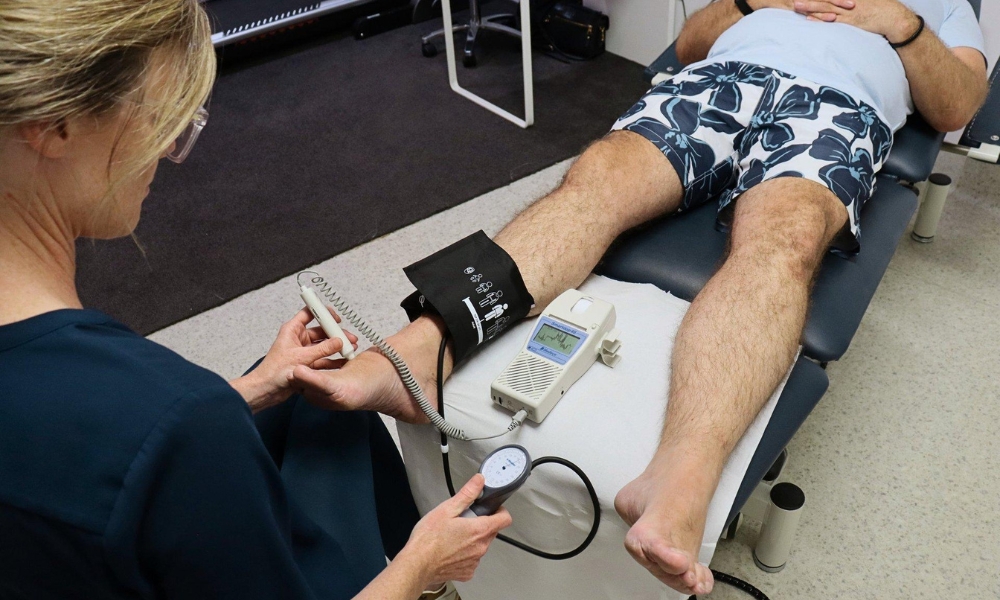
What Is an ABI Test?
An ankle-brachial index, commonly called an ABI, is a noninvasive test that compares blood pressure measured at the ankle with blood pressure measured at the arm.
The comparison can help identify reduced blood flow to the legs and may be used when PAD is suspected.
The test is generally straightforward. Blood pressure cuffs are placed around the arms and ankles, and the measurements are compared to assess circulation.
An ABI can be particularly useful when someone reports symptoms such as predictable calf pain while walking, unexplained leg fatigue, or other signs that suggest reduced arterial blood flow.
However, an ABI is only one part of the diagnostic process. Your healthcare provider will interpret the result together with your symptoms, examination findings, medical history, and other testing when necessary.
What If My Leg Pain Happens Only After Walking a Certain Distance?
A predictable walking distance is worth mentioning to your doctor.
For example, if you can walk comfortably for five or ten minutes but repeatedly develop calf aching after a similar amount of activity, that pattern may provide an important clue. It does not prove that you have PAD, but it is the kind of information that can help guide evaluation.
Try to describe the pattern as specifically as possible. Instead of saying, “My leg hurts when I walk,” you might explain, “My right calf starts aching after I walk about two blocks, and it improves after I stop for a few minutes.”
Details like these can make it easier for a healthcare professional to distinguish between vascular, joint, nerve, and muscular causes.

How Are PAD, Arthritis, and Sciatica Treated?
Treatment depends on the underlying cause, so identifying the source of the pain is the first step.
PAD Treatment
PAD treatment focuses on improving circulation, reducing cardiovascular risk, managing symptoms, and preventing complications. Depending on the severity and individual health factors, treatment may involve structured exercise, management of conditions such as high blood pressure and high cholesterol, medication, smoking cessation when applicable, and other cardiovascular interventions.
Some patients with significant arterial narrowing may require procedures designed to improve blood flow. The appropriate approach depends on the location and severity of the arterial disease.
Arthritis Treatment
Arthritis management varies depending on the type of arthritis and the affected joint. Treatment may include physical therapy, activity modification, medications, exercises designed to support joint function, and other interventions recommended by the treating clinician.
Sciatica Treatment
Sciatica treatment depends on what is irritating the nerve. Many cases are initially managed with conservative measures, while persistent or severe symptoms may require additional evaluation or specialist care.
The important point is that these conditions require different treatment strategies. Treating a circulation problem as though it were simply arthritis will not address the underlying arterial disease.
Can Lifestyle Changes Help With PAD-Related Leg Pain?
When PAD is responsible for walking-related leg discomfort, lifestyle and cardiovascular risk management can play an important role in long-term care.
Regular physical activity may be part of a structured treatment plan for people with PAD. Walking programs, when recommended and supervised appropriately, can help improve walking ability over time. The goal is not to push through severe or unusual pain without guidance, but to follow a plan designed around your cardiovascular health and physical limitations.
Managing other cardiovascular risk factors is equally important. High blood pressure, high cholesterol, diabetes, smoking, and other factors can contribute to vascular disease. Addressing these risks can help protect the arteries throughout the body.
For example, if you have high blood pressure or high cholesterol, working with your healthcare professional to manage those conditions can be an important part of your overall vascular care.
It is also important to avoid assuming that exercise-related leg pain is simply something you should tolerate as you get older. A change in your walking ability can sometimes be an early indication of a vascular problem.
Why Is It Important to Diagnose PAD Early?
PAD is not only a condition involving the legs. It is a sign that plaque and narrowing may be affecting arteries elsewhere in the body.
People with PAD may have an increased risk of cardiovascular events because the same underlying vascular disease can affect arteries supplying the heart and brain.
Recognizing PAD can therefore provide an opportunity to look more broadly at cardiovascular health.
Early evaluation may also help identify changes before circulation becomes severely compromised. If you notice that you can no longer walk as far as you once could because your legs repeatedly become painful, heavy, or tired, it is worth discussing the change with a healthcare professional.
Can You Have PAD and Sciatica at the Same Time?
Yes. Having one condition does not protect you from developing another.
This can make diagnosis particularly challenging. A person might have nerve-related pain coming from the lower back while also having reduced blood flow to the legs.
For example, sciatica may cause burning pain that travels down one leg and changes with sitting or bending. At the same time, PAD could cause calf discomfort after walking a predictable distance.
If both patterns are present, your healthcare team may need to evaluate both the nervous system and the circulation rather than assuming that one diagnosis explains everything.
This is particularly important when symptoms change. If treatment for an established back or joint problem improves one type of pain but walking-related symptoms continue, further evaluation may be appropriate.
What Questions Should You Ask Your Doctor About Walking-Related Leg Pain?
Preparing a few details before your appointment can make the conversation more productive.
Think about when the pain started and whether it has changed over time. Consider whether you can identify a predictable distance or activity level that brings it on.
It can also help to note whether the pain improves when you simply stand still, whether you need to sit down, or whether changing your back or leg position makes a difference.
Tell your healthcare professional if you have noticed cold feet, changes in skin color, slow-healing wounds, numbness, tingling, swelling, or weakness.
If possible, keep track of whether one leg is consistently more symptomatic than the other.
These details can help your clinician decide whether you may need an ABI, vascular ultrasound, joint evaluation, neurological assessment, or another diagnostic approach.
Vascular Evaluation in Houston, Tomball, and Cypress
Persistent leg pain with walking deserves appropriate evaluation, particularly when the symptoms suggest a possible circulation problem.
Apex Heart & Vascular Center provides cardiovascular and vascular care for patients in Houston, Tomball, and Cypress, Texas.
The practice evaluates symptoms including leg pain and claudication, leg swelling, shortness of breath, dizziness, chest pain, and other cardiovascular concerns. Diagnostic services include vascular ultrasound and other cardiovascular testing when clinically appropriate.
For people who may have PAD, evaluating circulation can help determine whether reduced arterial blood flow is contributing to walking-related symptoms. The appropriate testing depends on your medical history, symptoms, physical examination, and cardiovascular risk factors.
Leg Pain That Keeps You From Walking?
Recurring leg pain with activity can have several causes. If you are concerned that reduced circulation may be contributing to your symptoms, a cardiovascular evaluation can help determine what is happening.
Frequently Asked Questions About Leg Pain When Walking
How can I tell if my leg pain is from PAD?
PAD often causes aching, cramping, heaviness, or fatigue in the leg muscles after walking or exercise. The discomfort may improve after resting and return when you resume walking. Calf pain is common, but symptoms can occur elsewhere depending on where arterial narrowing is located. Medical testing is needed to confirm PAD.
Does PAD leg pain go away when you rest?
Classic intermittent claudication caused by PAD often improves after stopping activity and resting. The repeatable pattern of pain appearing with walking and improving with rest can be an important clue, although other conditions can also improve with rest.
What is the difference between PAD and sciatica?
PAD is caused by reduced blood flow through arteries supplying the legs and often produces activity-related muscle aching or cramping. Sciatica involves irritation of a nerve in the lower back and commonly produces shooting, burning, tingling, or radiating pain that travels into the leg.
What is the difference between PAD and arthritis?
PAD usually affects muscles because of reduced arterial blood flow, while arthritis affects joints. Arthritis commonly causes joint pain, stiffness, swelling, or discomfort related to movement and weight-bearing. PAD more classically produces predictable muscle discomfort during walking that improves with rest.
Can knee arthritis cause calf pain?
It can. Changes in the way you walk because of knee or hip arthritis can place additional stress on other muscles and tissues. However, recurring calf pain that consistently appears during walking should not automatically be attributed to arthritis, particularly if you have cardiovascular risk factors.
What does a blocked artery in the leg feel like?
A significantly narrowed or blocked leg artery can cause pain, cramping, heaviness, or fatigue, particularly during activity. More serious circulation problems may cause a cold, pale, blue, numb, or weak leg. Sudden severe symptoms require urgent medical evaluation.
What test checks circulation in the legs?
An ankle-brachial index, or ABI, compares blood pressure at the ankle with blood pressure at the arm and can help identify reduced arterial blood flow. Depending on the situation, healthcare professionals may also use vascular ultrasound or other vascular studies.
When should I see a doctor for leg pain when walking?
Make an appointment if leg pain repeatedly occurs during walking, limits your normal activity, is getting worse, or occurs with other symptoms such as cold feet, skin changes, slow-healing wounds, numbness, or weakness. Sudden severe leg pain with a cold, pale, blue, numb, or weak leg requires urgent medical attention.
Final Thoughts: The Pattern of Your Leg Pain Matters
Leg pain when walking is not always a simple muscle or joint problem. PAD, arthritis, and sciatica can all interfere with walking, but they affect the body in very different ways.
PAD often produces predictable muscle discomfort during activity that improves with rest. Arthritis tends to center around a painful or stiff joint, while sciatica more often causes nerve-like pain that can travel from the lower back or buttock into the leg.
These patterns can provide clues, but they cannot replace a proper medical evaluation. It is possible to have more than one condition, and symptoms do not always follow textbook descriptions.
If walking-related leg pain is new, persistent, worsening, or limiting your ability to stay active, talk with a healthcare professional. When PAD is suspected, tests such as an ABI or vascular ultrasound can help evaluate circulation.
Most importantly, do not ignore sudden severe leg symptoms. A cold, pale, blue, numb, or suddenly weak leg can signal a serious circulation problem and requires urgent medical attention.
Medical Disclaimer: This article is intended for general educational purposes only and does not replace professional medical advice, diagnosis, or treatment. Leg pain can have many causes, including vascular, neurological, joint, and muscular conditions. A qualified healthcare professional can determine which evaluations are appropriate based on your symptoms and medical history. Seek urgent medical attention for sudden severe leg pain accompanied by a cold, pale, blue, numb, or unusually weak leg.