

It can be unsettling when your heart suddenly starts beating differently. You may feel a flutter in your chest, notice your heartbeat pounding for no obvious reason, or become unexpectedly short of breath while doing something that normally feels easy. Sometimes the sensation lasts only a few minutes and disappears before you can figure out what happened. Other times, the irregular heartbeat continues and leaves you feeling tired, dizzy, or simply “off.”
One possible explanation is atrial fibrillation, commonly called AFib, an irregular heart rhythm that can cause the heart to beat rapidly and unevenly. But AFib does not feel exactly the same for everyone. Some people notice very obvious palpitations, while others experience fatigue, weakness, dizziness, reduced exercise tolerance, or no symptoms at all. That is one reason recognizing the different ways AFib can present is important.
Important Note: A racing or irregular heartbeat does not automatically mean you have AFib. Stress, exercise, dehydration, other heart rhythm problems, medications, and several medical conditions can cause similar sensations. Only an appropriate medical evaluation can determine what is causing your symptoms.
What Does AFib Feel Like?
AFib can feel like your heartbeat has suddenly lost its usual rhythm. Instead of a steady, predictable beat, you might notice fluttering, pounding, racing, or an irregular heartbeat. Some people describe the sensation as their heart “jumping around” or beating harder than usual. Others notice that their pulse seems uneven when they check it.
The sensation may be especially noticeable when you are resting because there are fewer distractions. You might be sitting on the couch, lying in bed, or trying to fall asleep when you suddenly become aware of your heartbeat. For some people, an episode begins during activity and comes with breathlessness or a feeling that they cannot exercise at their usual level.
AFib can also produce symptoms that do not initially seem related to the heart. Fatigue, lightheadedness, weakness, and shortness of breath can occur because the irregular rhythm can affect how efficiently the heart moves blood through the body.
Importantly, AFib can be completely symptomless. A person may have the condition and discover it during a routine examination or an electrocardiogram (EKG). This means the absence of noticeable symptoms does not necessarily mean the heart rhythm is normal.
If you have repeated episodes of an unexplained racing or irregular heartbeat, it is worth discussing them with a healthcare professional rather than assuming they are simply stress. Apex Heart & Vascular Center provides cardiovascular evaluation, including evaluation of heart palpitations and diagnostic testing when appropriate.
What Are the Most Common Symptoms of AFib?
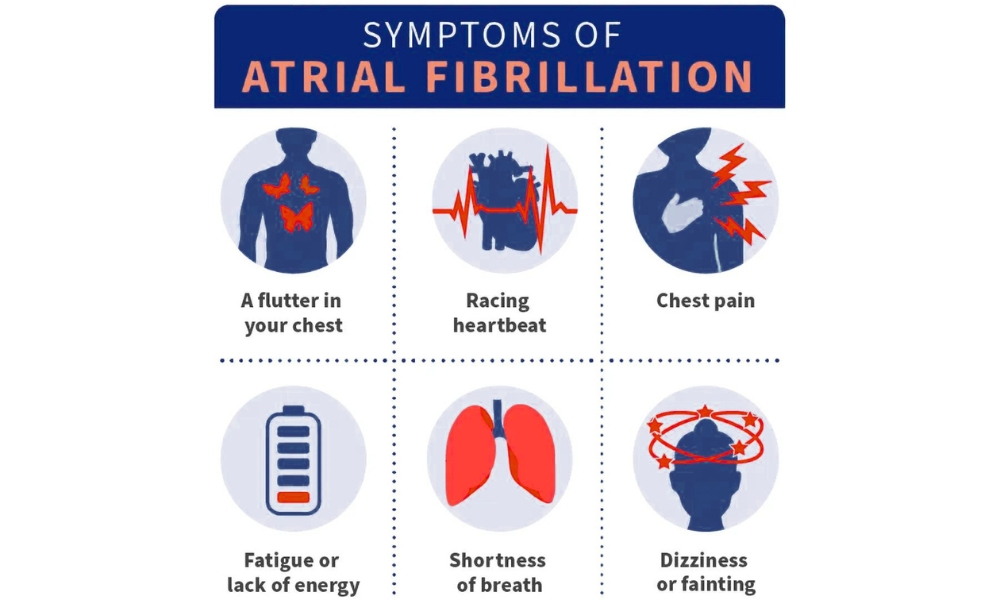
AFib symptoms can range from barely noticeable to quite uncomfortable. The most commonly reported symptoms include palpitations, shortness of breath, dizziness or lightheadedness, fatigue, weakness, reduced ability to exercise, and chest discomfort.
These symptoms can occur individually or together. For example, someone might first notice a fast, irregular heartbeat and then feel short of breath. Another person might mainly experience fatigue and reduced stamina without realizing that an abnormal rhythm is responsible.
Here is what some of the most common symptoms can feel like:
Palpitations or an Irregular Heartbeat
This is one of the symptoms people most strongly associate with AFib. Your heart may feel like it is fluttering, racing, pounding, or beating unevenly. You may notice pauses followed by stronger beats, although that sensation can also occur with other rhythm disturbances.
AFib-related palpitations may begin suddenly and may continue for minutes or longer. Some episodes stop on their own. Others persist and require medical treatment.
Shortness of Breath
You may feel as though you cannot take a satisfying breath, particularly during physical activity. Everyday activities such as walking up stairs may suddenly feel more difficult than usual.
Shortness of breath has many possible causes, including conditions involving the heart and lungs. If it is new, unexplained, recurring, or occurring along with an irregular heartbeat, it deserves medical attention. Apex Heart & Vascular Center also evaluates patients experiencing shortness of breath.
Dizziness or Lightheadedness
AFib may leave you feeling lightheaded, unsteady, or as though you might faint. Some people describe a vague sense that their head feels “foggy” during an episode.
Dizziness can have many explanations, so it should not automatically be attributed to AFib. However, dizziness occurring together with a rapid or irregular heartbeat is a reason to seek medical evaluation.
Fatigue and Weakness
Not everyone experiences AFib as a dramatic racing heartbeat. Sometimes the main clue is simply feeling unusually tired. You may notice that activities you normally tolerate leave you exhausted or that your energy level has changed without an obvious explanation.
Fatigue can be particularly easy to dismiss because it is common with poor sleep, stress, infections, and many other conditions. When persistent fatigue occurs with palpitations, breathlessness, dizziness, or reduced exercise tolerance, your heart rhythm should be considered as part of the evaluation.
Reduced Exercise Tolerance
You might notice that you become tired or short of breath sooner than you used to. A walk that normally feels comfortable may suddenly require more effort. Some people notice this before they become aware of any irregular heartbeat.
This does not mean every decline in exercise ability is caused by AFib. However, an unexplained change in how your body handles ordinary activity can be useful information for your healthcare provider.
What Do AFib Palpitations Feel Like?
AFib palpitations are often described as fast, fluttering, pounding, or irregular. Rather than feeling like a smooth, predictable heartbeat, the rhythm may seem chaotic or uneven.
You might feel the sensation primarily in your chest, but some people become aware of their heartbeat in their neck or notice their pulse feels irregular when they check it. The experience can be frightening, particularly if you have never felt anything similar before.
One important point is that palpitations do not equal AFib. A person can have palpitations with a normal heart rhythm, and several different types of arrhythmias can cause a similar sensation. Even stress or anxiety can make an otherwise normal heartbeat feel much more noticeable.
That is why doctors do not diagnose AFib based solely on how the heartbeat feels. An EKG or another form of rhythm monitoring may be needed to capture and identify the abnormal rhythm.
Apex Heart & Vascular Center offers electrocardiogram testing as part of its cardiovascular diagnostic services. Depending on how frequently symptoms occur, longer-term heart rhythm monitoring may also be considered.
Important Note: If your heart suddenly feels irregular, try to remember when the episode started, what you were doing at the time, how long it lasted, and what other symptoms occurred. These details can help a healthcare professional understand whether additional rhythm testing is appropriate.
Can AFib Cause Shortness of Breath?
Yes. Shortness of breath can occur during AFib, particularly when the heart is beating rapidly or irregularly. You may feel winded during activity, notice that you need to stop and catch your breath, or experience a general sense that breathing requires more effort than usual.
The reason can be easier to understand when you think about what happens during a normal heartbeat. The heart’s upper chambers, called the atria, normally contract in a coordinated rhythm that helps move blood into the lower chambers. During AFib, the atria beat chaotically rather than following a normal rhythm. This can interfere with the heart’s efficient filling and pumping.
For some people, the breathing difficulty is mild. For others, it can be one of the most noticeable symptoms. Shortness of breath may also occur with other cardiovascular conditions, including heart failure and coronary artery disease, so the symptom needs to be interpreted in context rather than used to diagnose AFib by itself.
If breathlessness is new, persistent, worsening, or accompanied by chest discomfort, fainting, severe weakness, or other concerning symptoms, prompt medical evaluation is important.
Concerned About an Irregular Heartbeat?
If you are experiencing recurring palpitations, unexplained shortness of breath, dizziness, or other symptoms that may involve your heart rhythm, a cardiovascular evaluation can help determine what is happening.
Why Can AFib Make You Dizzy or Tired?
Dizziness and fatigue can be easy to overlook because neither symptom necessarily feels like a heart problem. Yet both can occur with AFib.
When the heart rhythm becomes irregular, the amount of blood pumped with each heartbeat can vary. A person may therefore feel lightheaded, weak, or less energetic, especially during an episode. If the rhythm remains abnormal for an extended period, the resulting strain on the cardiovascular system can contribute to ongoing fatigue.
Still, dizziness and fatigue are broad symptoms. Dehydration, anemia, medication effects, blood pressure changes, thyroid problems, sleep disorders, infections, and many other conditions can produce similar sensations. The goal of a medical evaluation is not simply to confirm or rule out AFib, but to determine what is actually causing the symptoms.
Can AFib Cause Chest Pain or Pressure?
AFib can sometimes occur with chest discomfort, pressure, or pain, although chest pain is not present in everyone with atrial fibrillation. When it does occur, it may happen because the heart is beating rapidly and placing greater demand on the cardiovascular system. AFib may also occur alongside other heart conditions that can cause chest symptoms.
That distinction matters because chest pain should never automatically be blamed on AFib. A new or unexplained feeling of pressure, squeezing, heaviness, or pain in the chest can have several possible causes, including coronary artery disease and other potentially serious cardiovascular problems.
If chest discomfort is severe, persistent, or occurs with significant shortness of breath, fainting, sweating, nausea, or pain spreading toward the arm, shoulder, back, neck, or jaw, seek emergency medical attention rather than waiting for a routine appointment.
People who repeatedly experience unexplained chest discomfort may need a broader cardiovascular evaluation. Depending on the symptoms and medical history, testing may include an EKG, echocardiogram, stress testing, or other diagnostic studies.
Apex Heart & Vascular Center provides evaluation for chest pain as well as a range of cardiovascular diagnostic services.
Can You Have AFib Without Feeling It?
Yes. Some people with AFib have few or no noticeable symptoms. This is sometimes called asymptomatic or silent AFib. A person may feel completely normal while an irregular heart rhythm is occurring.
Silent AFib can be discovered during a routine physical examination, when a clinician notices an irregular pulse, or during an EKG performed for another reason. It can also be identified through heart rhythm monitoring when a person is being evaluated for unexplained symptoms.
This is one reason cardiovascular risk factors and medical history matter even when you feel well. Older age, high blood pressure, certain heart conditions, sleep-related breathing disorders, diabetes, obesity, and other factors can increase the likelihood of developing AFib.
Having no symptoms does not necessarily mean that AFib is harmless. One of the most important concerns associated with AFib is an increased risk of blood clots and stroke in some patients. The level of risk varies from person to person, which is why a clinician may assess your individual risk factors before recommending treatment.
If you have been diagnosed with AFib, following your treatment plan is important even if your heartbeat feels normal between episodes.
AFib vs. Heart Palpitations: How Are They Different?
AFib and heart palpitations are related terms, but they do not mean the same thing.
Heart palpitations are a symptom or sensation. They describe the feeling of being unusually aware of your heartbeat. You might experience pounding, fluttering, racing, skipped beats, or a sensation that your heart is beating harder than normal.
AFib is a specific abnormal heart rhythm. It occurs when the electrical activity in the atria becomes disorganized, causing the upper chambers of the heart to quiver rather than contract in a normal coordinated pattern.
In other words, AFib can cause palpitations, but experiencing palpitations does not mean you have AFib.
For example, you might notice your heart pounding after climbing several flights of stairs. That can be a normal response to exercise. Caffeine, stress, lack of sleep, fever, dehydration, and certain medications can also make your heartbeat feel more noticeable.
On the other hand, an unexplained heartbeat that suddenly becomes irregular or unusually fast, especially when you are resting, deserves attention. If episodes keep returning, last longer than expected, or occur alongside dizziness, shortness of breath, chest discomfort, or weakness, speak with a healthcare professional.
Apex Heart & Vascular Center evaluates heart palpitations and can determine whether further testing is appropriate.
Why You Cannot Diagnose AFib by Checking Your Pulse Alone
Checking your pulse can sometimes tell you that your heartbeat feels irregular, but it cannot reliably identify the exact rhythm problem. Several arrhythmias can produce a fast or uneven pulse, and some episodes of AFib may occur intermittently.
An EKG records the heart’s electrical activity and can identify AFib when the abnormal rhythm is occurring during the test. If symptoms come and go, however, a standard office EKG may be normal simply because the episode has ended.
In those situations, longer-term monitoring may help capture an abnormal rhythm when it happens. Your healthcare provider can decide which type of monitoring makes sense based on how often your symptoms occur.
When Should You Worry About AFib Symptoms?
Not every episode of a racing heartbeat is an emergency, but certain symptoms require immediate attention.
Seek emergency medical care if you experience severe or persistent chest pain, severe difficulty breathing, fainting, sudden severe weakness, new confusion, or symptoms that could indicate a stroke.
Stroke symptoms can include sudden weakness or numbness on one side of the body, sudden trouble speaking or understanding speech, sudden vision changes, severe loss of balance, or a sudden severe headache. These symptoms require emergency evaluation regardless of whether you have previously been diagnosed with AFib.
It is also important to seek prompt medical attention if you have a new, sustained, or unusually rapid irregular heartbeat, particularly if you also feel dizzy, weak, short of breath, or unwell.
For less urgent but recurring symptoms, schedule a cardiovascular evaluation. Keeping track of episodes can be useful. Write down when the symptoms started, how long they lasted, what your heartbeat felt like, whether you were exercising or resting, and whether you experienced other symptoms.
Important Note: Do not wait for an appointment if symptoms suggest a medical emergency. A new or severe combination of chest discomfort, significant breathing difficulty, fainting, or possible stroke symptoms needs urgent medical evaluation.
How Is AFib Diagnosed?
Doctors diagnose AFib by evaluating your symptoms, medical history, pulse, and heart rhythm. The key is to document the abnormal electrical rhythm rather than relying on symptoms alone.
Electrocardiogram (EKG)
An electrocardiogram, or EKG, is one of the most important tests used to identify AFib. Small sensors placed on the skin detect the heart’s electrical activity and produce a tracing that allows a healthcare professional to evaluate the rhythm.
An EKG is quick and noninvasive. However, it only captures the heart rhythm during the time the test is performed. If your AFib episodes are intermittent, your rhythm may look normal during a brief office test.
Apex Heart & Vascular Center offers electrocardiogram testing as part of its cardiovascular diagnostic services.
Heart Rhythm Monitoring
If your symptoms come and go, your doctor may recommend a heart monitor that records your rhythm for a longer period. The type of monitor depends on how frequently symptoms occur and what your clinician is trying to detect.
Some monitors record continuously for a set period, while others are designed to capture intermittent episodes. Longer monitoring can be particularly useful when a person describes occasional racing or irregular heartbeats but has a normal EKG between episodes.
Medical History and Physical Examination
Testing is only one part of the evaluation. Your doctor may ask when your symptoms began, how long they last, whether they happen during activity or rest, and whether anything seems to trigger them.
Your medical history also matters. High blood pressure, coronary artery disease, valve problems, heart failure, thyroid disorders, previous blood clots, sleep-related breathing problems, alcohol use, and certain medications may affect AFib risk or management.
Echocardiogram
An echocardiogram uses ultrasound to create images of the heart. It can provide information about the heart’s chambers, valves, pumping function, and overall structure.
An echocardiogram does not diagnose every case of AFib by itself. Instead, it can help doctors understand whether structural or functional heart problems may be present alongside the abnormal rhythm.
Learn more about the echocardiogram and how this noninvasive test can evaluate heart structure and function.
How Is AFib Treated?
AFib treatment is not identical for everyone. The appropriate approach depends on your age, symptoms, other medical conditions, stroke risk, heart function, how long the AFib has been present, and whether the rhythm occurs occasionally or continuously.
In general, treatment may focus on several goals: controlling the heart rate, restoring or maintaining a normal rhythm when appropriate, reducing the risk of blood clots and stroke, and addressing conditions that may be contributing to AFib.
Rate Control
Some people are treated with medications that slow the heart rate. The goal is not necessarily to make every heartbeat normal but to keep the heart from beating excessively fast and reduce symptoms and cardiovascular strain.
Rhythm Control
For selected patients, treatment may focus on restoring and maintaining a normal heart rhythm. Depending on the situation, this can involve medication, electrical cardioversion, or other rhythm-management strategies.
Stroke Prevention
Because AFib can increase the risk of blood clots forming in the heart, some patients need medication to reduce their risk of stroke. Not everyone with AFib needs the same medication or treatment intensity.
Your healthcare provider can assess your individual risk factors and determine whether anticoagulation or another strategy is appropriate.
Treating Underlying Cardiovascular Conditions
Managing high blood pressure, coronary artery disease, valve disease, heart failure, and other cardiovascular conditions can be an important part of AFib care.
For example, uncontrolled hypertension can place ongoing strain on the heart and contribute to cardiovascular problems. If you have high blood pressure, appropriate management is an important part of protecting your overall heart health. Apex Heart & Vascular Center provides evaluation and treatment for hypertension.
Get Your Heart Rhythm Evaluated
Recurring palpitations, unexplained dizziness, shortness of breath, or a known history of AFib should not be ignored. A cardiovascular evaluation can help identify the rhythm and determine what treatment may be appropriate.
Can AFib Symptoms Be Prevented or Reduced?
There is no single way to prevent every case of AFib, and some people develop the condition despite taking good care of their health. However, managing cardiovascular risk factors can help reduce the likelihood of AFib episodes and support overall heart health.
One of the most important steps is keeping blood pressure under control. High blood pressure can place long-term stress on the heart and is an important risk factor for atrial fibrillation. Regular monitoring and following your prescribed treatment plan can make a meaningful difference.
Managing cholesterol, maintaining an appropriate level of physical activity, avoiding tobacco, getting adequate sleep, and maintaining a healthy weight can also support cardiovascular health. If you have diabetes or another chronic condition that affects your heart and blood vessels, working with your healthcare team to manage it is important.
It is also useful to pay attention to factors that appear to trigger your own episodes. Some people notice symptoms after poor sleep, significant stress, dehydration, illness, or excessive intake of stimulants. Alcohol can also contribute to AFib episodes in some individuals. Your triggers may not be the same as someone else’s, so keeping a symptom record can help identify patterns.
Do Not Stop Heart Medication on Your Own
If you have already been diagnosed with AFib and take medication to control your heart rate, maintain rhythm, or reduce stroke risk, do not stop or change the medication simply because you feel better.
AFib can come and go, and feeling normal does not necessarily mean the underlying risk has disappeared. Medication decisions should be made with the healthcare professional managing your condition.
Keep Track of Recurring Symptoms
A simple record can be surprisingly useful. Write down the date and time an episode begins, how long it lasts, what your heartbeat feels like, and whether you experience symptoms such as dizziness, fatigue, chest discomfort, or shortness of breath.
If you have a way to measure your heart rate or blood pressure at home, you can record those readings as well. These measurements do not replace professional diagnosis, but they may provide useful information during an appointment.
Most importantly, do not dismiss repeated symptoms simply because each episode eventually goes away. Intermittent symptoms can still deserve investigation.

AFib Care in Houston, Tomball, and Cypress, TX
If you are experiencing recurring palpitations, unexplained shortness of breath, dizziness, fatigue, or an irregular heartbeat, the next step is understanding what is causing those symptoms. AFib is one possibility, but a proper cardiovascular evaluation can help distinguish it from other rhythm disorders and heart conditions.
Apex Heart & Vascular Center provides cardiovascular evaluation and treatment for patients in the Houston area, with convenient offices in Houston, Tomball, and Cypress, Texas.
The practice provides diagnostic services that may be relevant when evaluating possible heart rhythm problems, including EKG testing, echocardiography, heart monitoring, and other cardiovascular testing when clinically appropriate.
Dr. Yasir Akram, MD, MPH, FACC, FSCAI, and the Apex Heart & Vascular Center team provide care for a broad range of heart and vascular conditions. Patients can also receive evaluation for symptoms such as dizziness, fatigue, shortness of breath, and heart palpitations.
The Houston office is located at 17070 Red Oak Drive, Suite 400, Houston, TX 77090. The Tomball office is located at 155 School St, Suite 220, Tomball, TX 77375, while the Cypress office is located at 16700 House & Haul, Building 8-A, Cypress, TX 77433.
Experiencing Possible AFib Symptoms?
Do not try to determine the cause of recurring palpitations or an irregular heartbeat based on symptoms alone. A cardiovascular evaluation can help identify whether AFib or another heart rhythm problem may be involved.
Frequently Asked Questions About AFib Symptoms
What does AFib feel like?
AFib can feel like a racing, pounding, fluttering, or irregular heartbeat. Some people also experience shortness of breath, dizziness, weakness, fatigue, reduced exercise tolerance, or chest discomfort. Others have no noticeable symptoms at all. Because several conditions can cause similar sensations, symptoms alone cannot confirm AFib.
How do I know if my irregular heartbeat is AFib?
You cannot reliably determine whether an irregular heartbeat is AFib just by how it feels or by checking your pulse. An EKG can identify AFib when the abnormal rhythm is occurring. If symptoms are intermittent, longer-term heart rhythm monitoring may be needed to capture an episode.
Can AFib come and go?
Yes. Some people experience episodes that begin and stop on their own. This pattern is commonly referred to as paroxysmal AFib. Because an episode may disappear before you reach a doctor’s office, documenting symptoms and using appropriate heart rhythm monitoring can be helpful.
Can AFib cause shortness of breath?
Yes. AFib can cause shortness of breath, particularly when the heart is beating rapidly or irregularly. However, breathing difficulty can have many causes, including other heart and lung conditions. New or worsening shortness of breath should be medically evaluated.
Can AFib make you tired?
Yes. Fatigue is a possible symptom of AFib. An irregular rhythm can affect how efficiently the heart pumps blood, and some people notice reduced energy or exercise tolerance during episodes. Persistent fatigue can also have many other causes, so it should be evaluated in context.
Can you have AFib and not feel anything?
Yes. Some people have asymptomatic or “silent” AFib and do not notice any symptoms. AFib may be discovered during an EKG, physical examination, or heart rhythm monitoring performed for another reason.
Is AFib dangerous?
AFib can be serious because it can increase the risk of blood clots and stroke in some people. The level of risk depends on individual factors, so a diagnosis should be followed by an appropriate medical evaluation and individualized treatment plan.
When should I go to the emergency room for AFib symptoms?
Seek emergency medical attention for severe or persistent chest pain, severe difficulty breathing, fainting, sudden severe weakness, or symptoms that may indicate a stroke, such as sudden one-sided weakness, difficulty speaking, sudden vision changes, or significant loss of balance. Do not wait for a routine cardiology appointment when symptoms suggest a medical emergency.
Can stress cause symptoms that feel like AFib?
Stress can make your heartbeat feel faster or more noticeable and can cause sensations that resemble palpitations. However, it is important not to assume that recurring or unusual heart rhythm symptoms are simply stress. If the episodes keep happening, medical evaluation can determine whether an abnormal rhythm is present.
Final Thoughts: Pay Attention When Your Heartbeat Changes
So, what does AFib feel like? For some people, it feels like a sudden fluttering or racing heartbeat. For others, the first clue may be shortness of breath, dizziness, unusual fatigue, weakness, or reduced ability to exercise. And for some people, there may be no symptoms at all.
That wide range of experiences is exactly why AFib can be difficult to recognize based on symptoms alone. A sensation that feels like a simple palpitation could have several possible explanations, while an important heart rhythm problem may sometimes produce surprisingly subtle symptoms.
If you repeatedly notice an irregular heartbeat or unexplained symptoms that occur alongside palpitations, it is worth discussing them with a cardiovascular professional. Appropriate testing can help determine what your heart rhythm is doing and whether further treatment is necessary.
And if symptoms are severe or suggest a heart attack or stroke, do not wait for a scheduled appointment. Seek emergency medical care.
Medical Disclaimer: This article is intended for general educational purposes only and does not replace professional medical advice, diagnosis, or treatment. Symptoms of AFib can overlap with other heart and medical conditions. If you are experiencing new, severe, or worsening symptoms, contact a qualified healthcare professional or seek emergency medical care when appropriate.